Dead Vlei vs Sossusvlei: What's the Difference?
Unveiling the Heart of the Namib
To travel into the heart of the Namib-Naukluft National Park is to step into a landscape painted by time itself. Here, under an immense sky, the world’s oldest desert reveals its most famous icons. Yet, among travelers, a common point of confusion arises: the question of Dead Vlei vs Sossusvlei. Are they the same? Are they rivals for the title of the desert’s most stunning feature?
The simple answer is that they are not the same, but they are intrinsically linked. Think of Sossusvlei as the famous capital city and Deadvlei as its most breathtaking, historically significant neighborhood. They are breathtakingly beautiful neighbours, each offering a distinct but complementary experience. To truly appreciate this corner of Namibia, one must understand and visit both.
Sossusvlei: The River That Seldom Flows
Let’s begin with the namesake of the entire region: Sossusvlei. The name is a thoughtful blend of languages, combining “sossus” (a Nama word for “dead-end” or “no return”) and “vlei” (an Afrikaans word for a shallow pan or marsh). It literally means “dead-end marsh,” and it perfectly describes the pan's function.
Sossusvlei is the final, dramatic terminus for the Tsauchab River, a river that flows from the Naukluft Mountains but rarely has the strength to reach the Atlantic Ocean. Instead, its journey is halted by the monumental sea of sand. For most of the year, Sossusvlei is a vast, salt-crusted pan cradled by colossal, star-shaped dunes. It is a place of immense scale and profound silence.
However, in years of exceptional rainfall—a rare and celebrated event—the Tsauchab River pushes through, filling the vlei with water. When this happens, Sossusvlei transforms into a surreal spectacle: a turquoise lake reflecting the fiery orange of the surrounding dunes. It’s a photographer’s dream and a life-affirming sight for anyone lucky enough to witness it.
Visiting Sossusvlei is about experiencing this sheer scale. It is the gateway to the other wonders of the area and the central hub from which your explorations will begin. You can find more details about planning a trip in our guide to the Sossusvlei region.
Climbing the Giants: Dune 45 and Big Daddy
No visit to the Sossusvlei area is complete without attempting to climb one of its iconic dunes. Dune 45 is the most famous, so-named because it is located 45 kilometers from the Sesriem Gate. Its relatively accessible ridge makes it a popular spot for watching the sunrise cast its first golden light across the endless dune sea.
For the more adventurous, there is Big Daddy. Standing at over 325 meters, it is one of the highest dunes in the area, a true behemoth of sand. The climb is strenuous, a one-step-forward-half-a-step-back journey on soft sand. But the reward is one of the most sublime views in all of Africa: a panoramic vista that includes the entire Sossusvlei basin and, nestled at its foot, the stark white pan of Deadvlei.
Deadvlei: A Sun-Scorched, Silent Spectacle
After descending Big Daddy, or by taking a short walk from a nearby 4x4 drop-off point, you enter another world entirely: Deadvlei. If Sossusvlei is about grand scale, Deadvlei is about intimate, haunting beauty.
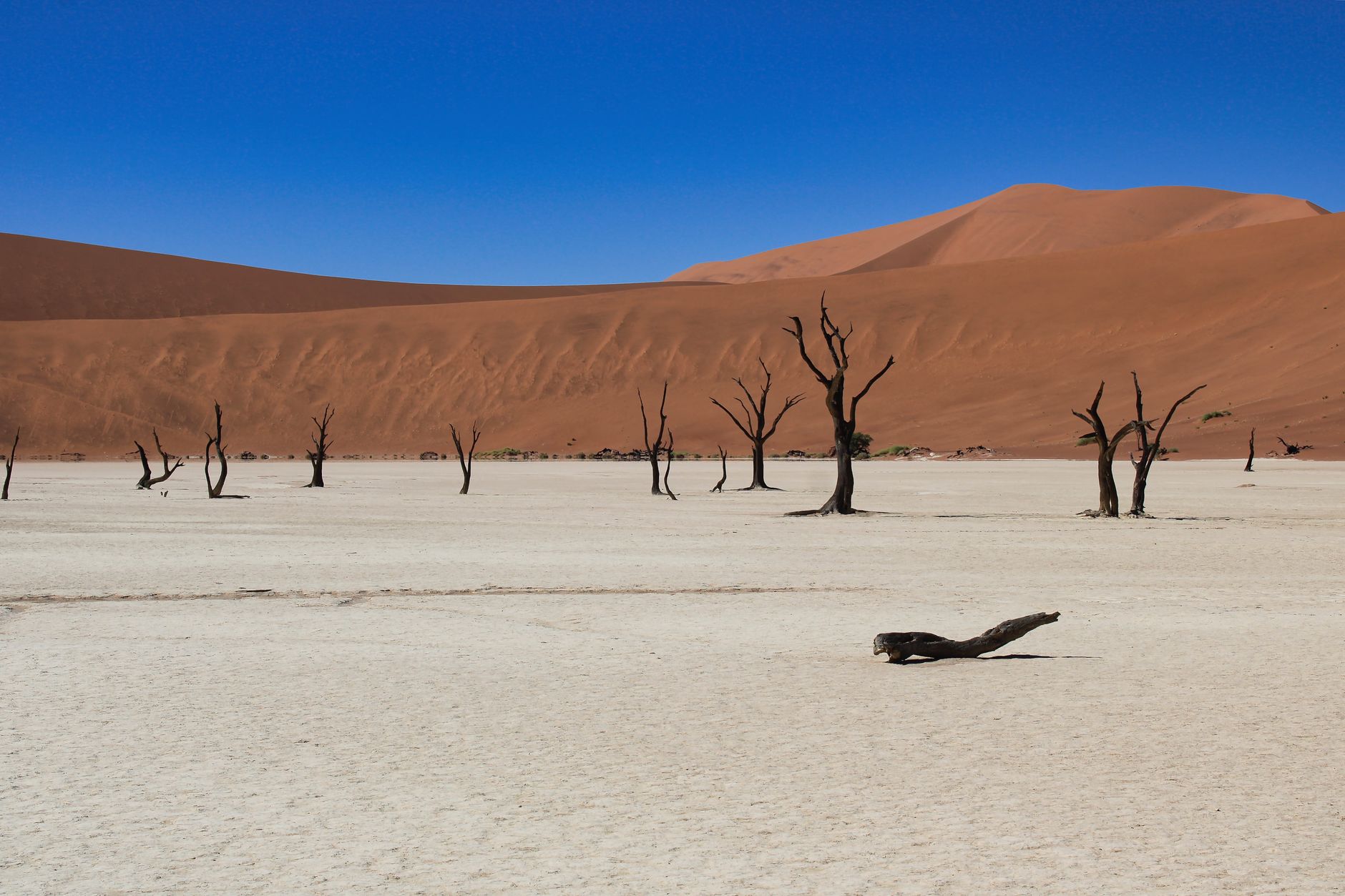
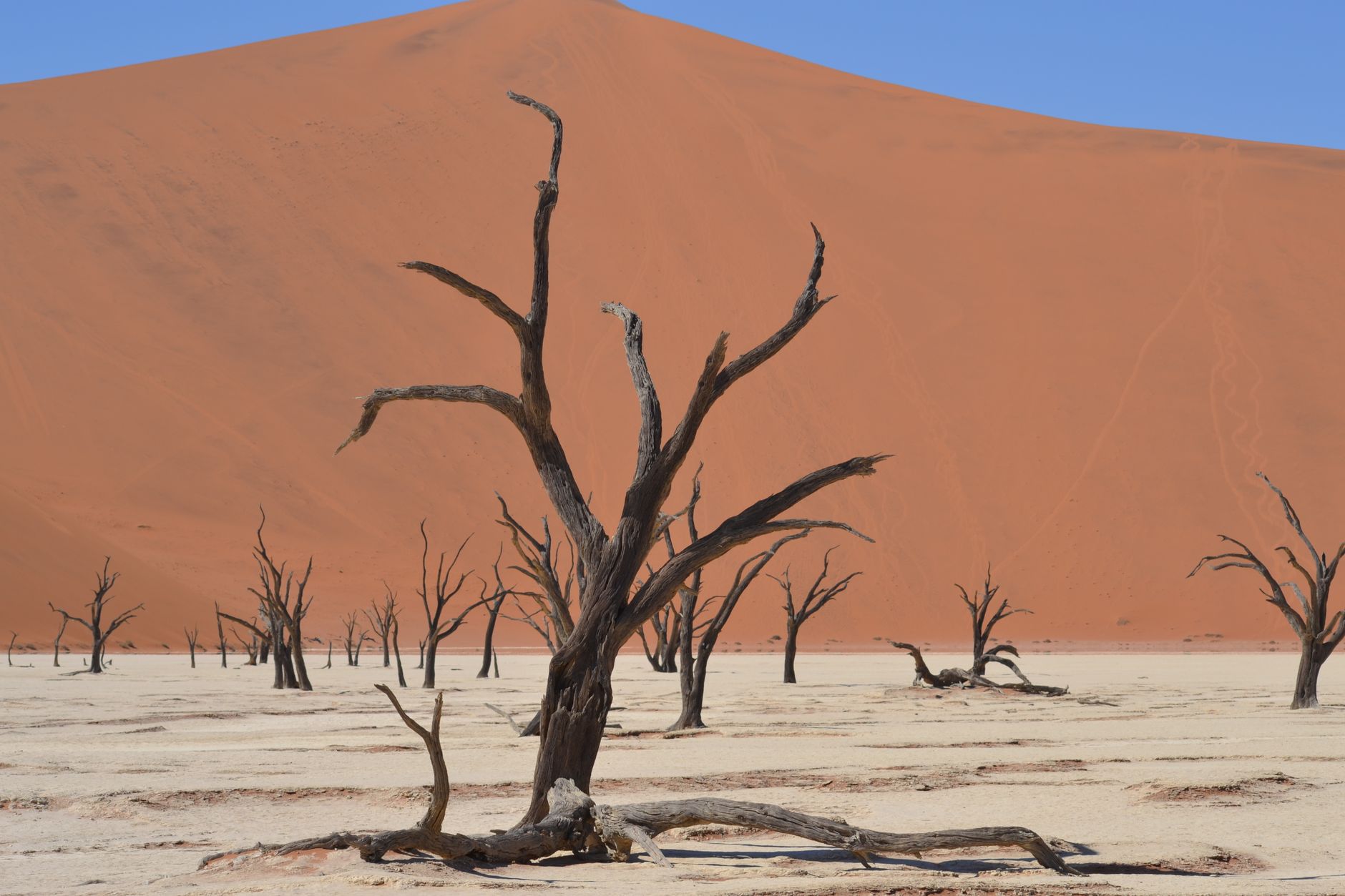
Here, the ground is a mosaic of cracked white clay, a stark contrast to the red sand. Puncturing this otherworldly floor are the skeletal remains of camel thorn trees. Their blackened, twisted limbs reach towards a sky that is almost always a deep, cloudless blue. These trees are estimated to be over 900 years old.
Their story is the story of the desert’s changing nature. Centuries ago, the Tsauchab River flowed here more freely, nourishing a small forest. The trees thrived. Then, shifting dunes blocked the river’s path, cutting off the water supply. The trees died, but they did not disappear. The climate is so intensely dry that the wood could not decompose. Instead, the relentless sun scorched them black, petrifying them in place—a silent, sun-baked monument to life that once was.
Walking among these ancient skeletons is a humbling and deeply moving experience. The silence is profound, broken only by the whisper of the wind and the crunch of your own footsteps on the clay. It’s a place that feels frozen in time, a natural art installation of staggering beauty.
The Core Difference: Dead Vlei vs Sossusvlei
So, to bring it all together, what is the essential difference when comparing Dead Vlei vs Sossusvlei? It’s best understood by looking at their distinct characteristics.
- Geography: Sossusvlei is the larger area and the primary pan at the end of the Tsauchab River course. Deadvlei is a smaller, separate clay pan located about two kilometers away.
- Appearance: Sossusvlei is a vast, sandy basin that occasionally holds water. Deadvlei is a white clay pan defined by its collection of ancient, skeletal trees.
- Access: You drive to the Sossusvlei 4x4 parking area. From there, Deadvlei is a 1.1km walk into the pan, while the main Sossusvlei pan is a little further along the 4x4 track.
- Experience: Sossusvlei offers a sense of immense space, dune climbing, and the rare magic of water in the desert. Deadvlei provides a surreal, photographic, and poignant encounter with a landscape frozen in time. A trip focused on photographing Namibia's deserts must include both.
Ultimately, they are not in competition. A visit here is a two-part story: the grand context of Sossusvlei and the specific, haunting chapter of Deadvlei.
Planning Your Visit: Practicalities and Tips
To make the most of your trip, a little planning goes a long way. Both sites are located within the Namib-Naukluft National Park, with the entrance gate at Sesriem.
This gate opens at sunrise and closes at sunset. The drive from the gate to the 2x4 parking area is on a 60km stretch of sealed tarmac. The final 5km to Sossusvlei and the Deadvlei trail requires a 4x4 vehicle due to the very soft sand. If you don't have a 4x4, you can park and take the convenient park-operated shuttle.
Timing is everything in the desert. An early morning start is essential. Not only will you catch the most beautiful light as the sun angles across the dunes, but you will also avoid the punishing midday heat. The sand is also firmer and easier to walk or drive on in the cool morning air.
Be prepared. Essentials include at least 1.5 liters of water per person, a wide-brimmed hat, high-SPF sunscreen, sunglasses, and comfortable, closed-toe shoes. And, of course, your camera. You will be using it.

Where to Stay
Staying as close to the park gate as possible is a significant advantage. Lodges and campsites inside the park, like those at Sesriem, allow guests to enter the dune sea an hour before the general public at sunrise. Nearby, exclusive properties like the exquisite Sossusvlei Desert Lodge offer luxurious comfort on private reserves, with guided tours that handle all the logistics for you, ensuring a seamless and memorable experience.
Neighbours in Sublime Beauty
In the end, the debate of Dead Vlei vs Sossusvlei resolves into a simple, beautiful truth: you cannot have one without the other. They are two parts of a single, unforgettable story—a story of time, of water, of life and its absence, all written on a canvas of sand and stone. To journey into this part of the Namib is to witness one of the planet's most magnificent landscapes, a place that will capture your imagination and linger in your memory long after the red dust has settled.
The landscapes of the Namib-Naukluft are waiting to be explored. From the peaks of the blood-red dunes to the silent floors of ancient pans, this is a journey that stays with you. Begin planning your Namibian adventure by browsing our curated collection of exclusive safari lodges in the heart of this unforgettable region.
Ready to plan your trip?
Check live availability, compare lodges and book instantly — or send us an enquiry and we'll help shape the route.